AI Overview: What It Is and How to Get Cited in One
What a Google AI Overview is, how Google picks the pages it cites, and the steps that give your pages a real shot at being one of those links.
KiwiRank ·
In short
- An AI Overview is Google's AI-written answer, shown with links to the pages that support it.
- Ranking in the top 10 helps less than it used to: Ahrefs data reported by Stridec puts cited pages in the top 10 at 38%, down from 76%.
- Put the direct answer near the top. CXL found 55% of cited passages came from the first 30% of a page.
- Cover the follow-up questions Google breaks a search into, on one page with clear question headings.
- Check citations in Search Console's Generative AI report and by hand, several times, because the order rotates.
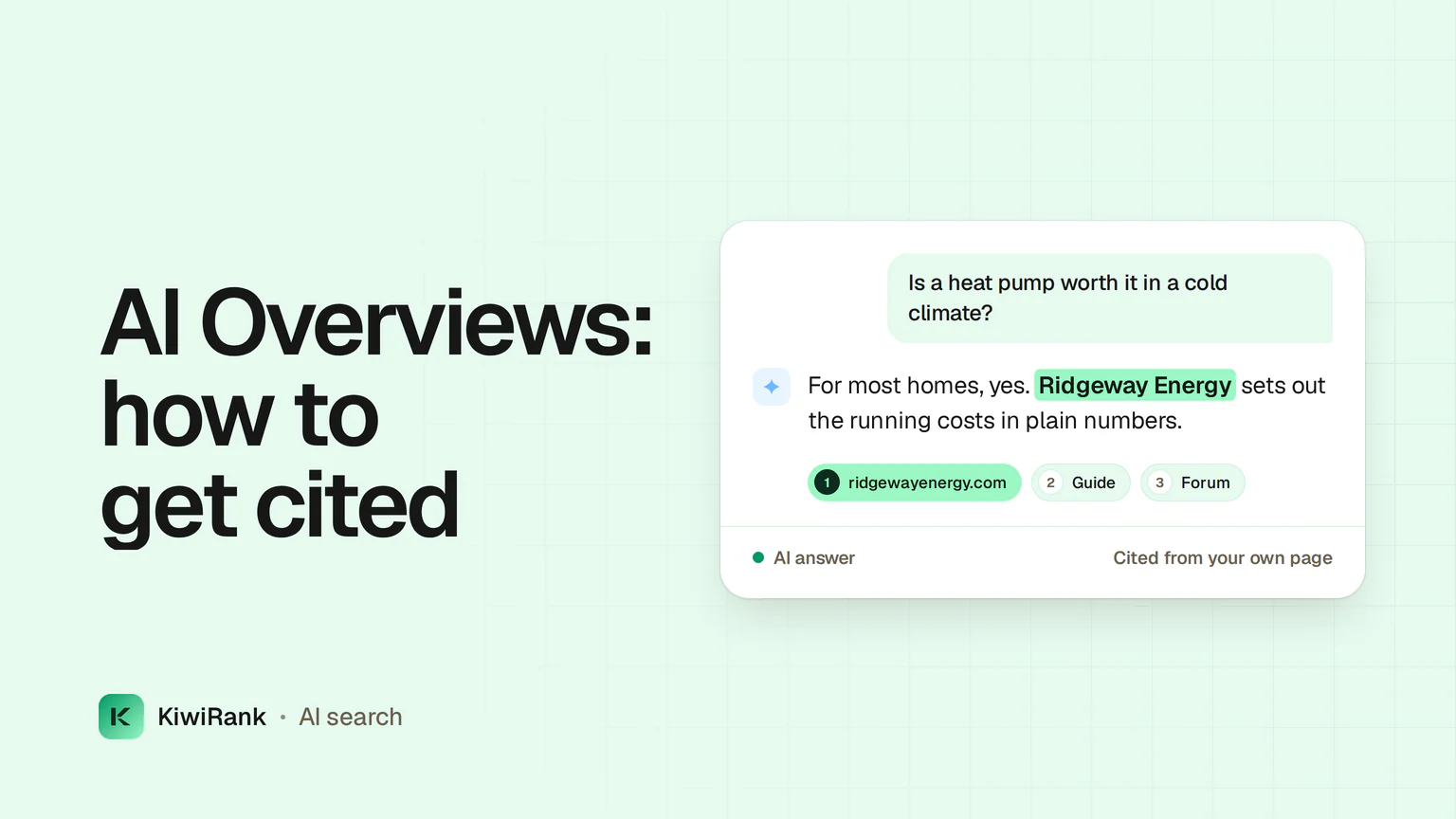
A Google AI Overview is the AI-written answer at the top of a Google results page, with links to the pages it drew from. To get cited, publish indexable pages that answer the question in the opening lines, cover the follow-up questions on the same page, back claims with dated sources, and keep building depth on your topic.
What a Google AI Overview is
A Google AI Overview is the AI-written answer that sits at the top of a Google results page, with links to the pages it drew from. You get cited in one by publishing pages Google can index, that answer the question near the top, and that cover the follow-up questions a searcher would ask next.
It is not a featured snippet. According to Blue Archer, a snippet usually pulls from a single page, while an AI Overview blends several sources and shows multiple citations. More seats at the table. More competition for each one.
A citation is the link to your page shown with that answer. Semrush defines AI citations as linked references to the sources an AI system used to generate or support a response. A plain reference to your brand with no link is an AI mention, which is a different thing. Semrush also notes that Google AI Overviews always provide citations, because they are tied to traditional search.
The reach is real. Stridec, citing a Position Digital analysis of 21.9 million queries, says AI Overviews now appear in roughly 25% of Google searches.
Why a citation is worth the work
Ranking first no longer means the click is yours. CXL points to Ahrefs data showing AI Overviews have cut clicks to top-ranking content by up to 58%. If the answer sits above your link, many people stop there.
Being one of the cited sources wins some of that back. Mintec reports a 2026 Seer Interactive study of 53 brands and 5.47 million queries. On informational queries with an AI Overview, cited brands averaged 2.07% organic click-through rate, against 0.94% for brands that were not cited. Queries with no AI Overview sat at 3.35%.
Order inside the overview matters too. Mintec, using Datos clickstream data compiled by Searchlab, says the first cited source takes 47% of the clicks that leave the panel, the second 23% and the third 14%. Mintec is open about the limits: it could not find the primary table behind those figures, and a Pew study using an Ipsos panel recorded clicks to cited sources on just 1% of visits to pages with an AI Overview.
The layout raised the stakes. Mintec reports that on May 6, 2026, Google moved citations from a grouped list at the end of the summary to inline links next to the sentence they support. The first claim in the answer now carries the first source.
Clicks are not the only payoff. Readers see your name next to the answer even when they don't click. And Semrush's AI search study suggests visitors from AI search experiences are 4.4x more likely to convert than visitors from traditional search.
How Google chooses which pages to cite
Start with the floor. As Mintec relays from Google, a page must be indexed and eligible to show with a snippet to appear as a supporting link. Every cited page has cleared that bar. Past it, a few patterns stand out.
Top-10 rankings carry less weight. Stridec cites an Ahrefs study of 863,000 keywords and 4 million AI Overview URLs: only 38% of cited pages also ranked in the organic top 10, down from 76% in mid-2025. Pages further down can still be picked.
Google splits your search into smaller questions. Stridec calls these fan-out queries and cites Search Engine Land research showing that ranking for them boosts AI Overview citation odds by 161%. A page that answers the sub-questions gives Google more reasons to use it.
Where your answer sits on the page counts. Stridec reports CXL's study of 100 pages, which found 55% of citations came from the top 30% of a page's content, while the bottom 40% contributed just 21%. Mintec adds Kevin Indig's finding, via Search Engine Land, that 44.2% of citations come from the first 30% of the page, and that cited passages run near 20% proper-noun density against 5-8% for generic prose.
Page type matters as well. Stridec cites a Search Engine Land study of 8,000 AI citations: blog articles accounted for about 46% of AI Overview citations and news articles about 20%, and 82.5% of citations linked to deeply nested pages rather than homepages.
Blue Archer sums up the other signals: authority and trust, clear answers that match intent, a mix of perspectives, fresh content and well-organised pages with clear headings.
How to get cited: eight steps
- Make the page eligible. It needs to be indexed, crawlable and allowed to show a snippet, with the important content in text. Semrush notes that AI crawlers generally read raw HTML, so server-side rendering helps, and content behind a registration or payment wall may be out of reach.
- Open with the answer. Mintec suggests a 40 to 70 word paragraph that answers the query directly, before any introduction. Stridec puts the clearest answer in the first 100-150 words.
- Write passages that stand alone. Semrush advises sentences and paragraphs that make sense in isolation. Mintec recommends definitions in the 'X is Y' form with the subject named, so they survive being lifted out.
- Turn sub-questions into headings. Use headings that are real questions and answer each one in its first sentence. Cover related questions on one page instead of spinning up a thin page for every variation.
- Keep each claim with its number, source and date in the same paragraph. Mintec cites Princeton research finding that a new statistic lifts citation rates by 32%, and an inline citation to a recent source by 30%.
- Add something only you can say. Blue Archer recommends original research, survey results and case studies, because AI tools are more likely to cite information they can't find elsewhere.
- Build depth on your topic. Stridec suggests ten to fifteen interconnected pieces across a topic cluster, plus Organisation schema, consistent brand details across platforms and clear author credits. It also cites WPRiders data that FAQPage schema makes content 3.2 times more likely to appear in AI Overviews.
- Refresh what you publish. Blue Archer suggests revisiting top articles every 6–12 months to update statistics and add new insights.
Steps one to six happen on a single page. Step seven is the slow part: it means publishing steadily on your topic for months. That is the work most small teams never get to.
It's why we built KiwiRank. It reads your website, then plans, writes, illustrates and publishes an article for your business every day, made to be found on Google and in AI answers. You get the depth without writing it yourself.
Mistakes that keep pages out of AI Overviews
- Burying the answer. Three paragraphs of context before the point pushes your best passage into the part of the page that gets cited least.
- Thin or generic content. Blue Archer warns that pages repeating the same advice as dozens of others give Google little reason to pick them.
- Keyword stuffing. It reads badly and, per Blue Archer, signals an attempt to manipulate rankings rather than help.
- Stranded statistics. Mintec notes that a source sitting three hundred words away from the claim it supports drops out when the passage is extracted.
- One thin page per variation. Covering close sub-topics in separate short articles spreads your answers thin. Group them on one page.
- Stale pages. Outdated figures lose out to fresher pages on the same question.
- Skipping your own sources. Blue Archer points out that linking to credible studies builds the trust you want Google to see.
- Trusting a single check. The sources in an AI Overview rotate, so one search proves little.
How to check whether you're cited
Google now gives you a direct view. Mintec reports that Search Console launched its Generative AI features report in June 2026 and extended it to all sites on August 31. It shows impressions by page, country, device and date. It does not show queries, clicks or where your link sits in the order.
So pair it with a manual check. Mintec's routine takes about twenty minutes:
- Pull your ten pages with the most impressions in the Generative AI report.
- Search each page's target query, expand the summary and note where your citation sits against the others.
- Run each query three times and write down whether the order holds.
- Sort the pages into 'lost the first citation' and 'not cited'. They are different problems with different fixes.
Expect movement. Mintec cites a SISTRIX crawl finding about 11 domains per AI answer, with 8 holding steady and 3 rotating. A drop on one search may not be a drop at all.
| Method | What it shows | What it misses |
|---|---|---|
| Search Console Generative AI report | Impressions by page, country, device and date | Queries, clicks and citation order |
| Manual searches | Whether an overview shows and which links it holds | Only one snapshot; the order rotates |
| Third-party trackers | Ongoing monitoring across many keywords | Counts come from each tool's own checks |
| Analytics | Traffic spikes around specific queries | No direct proof a citation caused them |
Blue Archer lists trackers that follow AI Overview visibility, including Advanced Web Ranking, SE Ranking, Semrush and seoClarity, and still recommends confirming with manual searches. KiwiRank also tracks how often your business shows up in AI answers, alongside the articles it publishes.

Citing an AI Overview in your own writing
Some people searching this phrase want the opposite: how to reference an AI Overview in an essay or report. The MLA Style Center says not to. It treats AI Overviews as search results, and search results are not a work.
Instead, click through to the linked source, read the passage in context and cite that page. The MLA warns that an overview may pull a quote that doesn't mean what the summary implies, and that results change from search to search. Purdue Libraries gives the same advice for AI tools in general: read and cite the original source rather than the AI-generated summary.
That advice cuts both ways. If careful readers click through to check the source, your page needs to back up the exact claim it is cited for.
Conclusion
AI Overviews reward pages that get to the point. Put the answer at the top, cover the follow-up questions on the same page, keep each claim next to its source, and check your citations more than once because the order moves. The page work is quick. The depth takes steady publishing. If you want that depth without writing it yourself, KiwiRank writes and publishes an article for your business every day, made to be found on Google and in AI answers. Get started with KiwiRank and let your next article start working for you.
Frequently asked questions
Do I need to rank in the top 10 to be cited in an AI Overview?
No. Stridec reports Ahrefs data showing only 38% of cited pages ranked in the organic top 10, down from 76% in mid-2025. Your page still has to be indexed and eligible for a snippet.
Does schema markup guarantee a citation?
No. It helps Google understand the page. Stridec cites WPRiders data that FAQPage schema makes content 3.2 times more likely to appear, but nothing guarantees a citation.
Can a small business get cited?
Yes. Blue Archer says smaller sites can earn citations by focusing on niche topics, local relevance and well-structured pages, where competition is lighter.
How long does it take to get cited?
There is no fixed timeline. Blue Archer notes that some citations appear quickly while others take months of steady effort, depending on your site's authority and how competitive the topic is.