Answer engine optimization means making your business easy for AI tools to read, trust and quote. Let AI crawlers in, put the direct answer at the top of each page, keep your facts identical everywhere, earn reviews and outside mentions, and check each month whether ChatGPT and Google AI Overviews name you. It builds on SEO rather than replacing it.
What answer engine optimization actually means
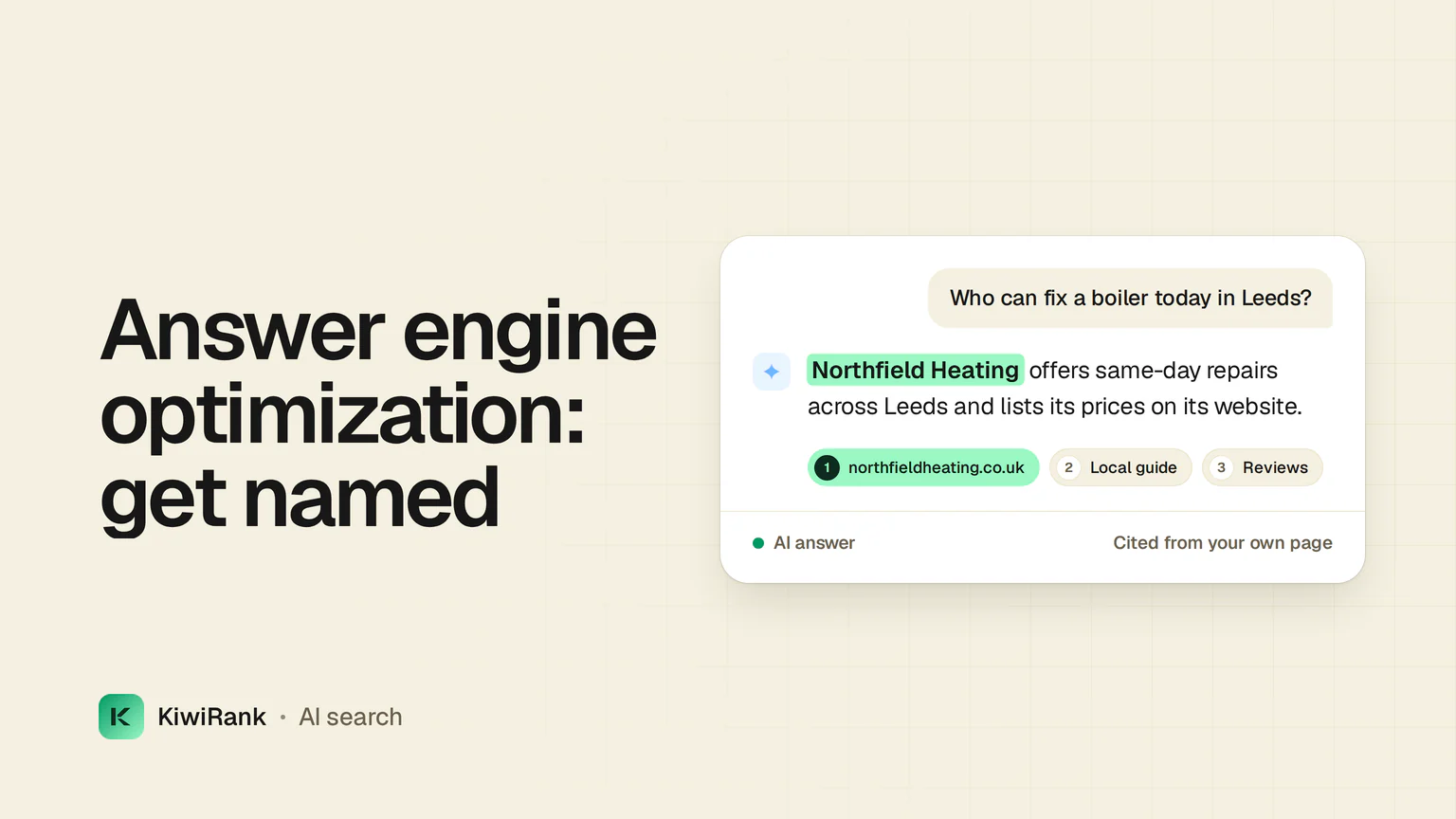
Answer engine optimization gets your business named when someone asks an AI a question. Instead of ranking in ten blue links, you become part of the single answer people read and act on.
Amsive defines AEO as optimizing content to get cited by ChatGPT, Google AI Overviews, Perplexity and Bing Copilot. You will also see it called generative engine optimization (GEO), LLM optimization or AI search optimization. The labels differ. The goal is the same: get cited, summarised or named by AI tools.
Here is the key point. AEO is not a new discipline that replaces SEO. It sits on top of it. The same clear pages, consistent facts and trust signals that help you rank on Google also help an AI quote you.
| Classic SEO | Answer engine optimization | |
|---|---|---|
| Goal | Rank in the list and earn clicks | Get named or quoted inside the AI answer |
| Where you appear | Google results pages | ChatGPT, Google AI Overviews and AI Mode, Perplexity, Gemini |
| How pages open | Often warm up before the point | Direct answer first, detail after |
| What you measure | Rankings, clicks, organic traffic | How often AI answers name or cite you |
Why AI answers are worth your time now
Your buyers already ask AI who to hire. Omni Online Strategies cites BrightLocal's 2026 Local Consumer Review Survey, which found 45 percent of consumers used AI for local business recommendations in the past year, up from 6 percent. The same piece cites G2 research showing 51 percent of B2B software buyers start research in an AI chatbot more often than in Google.
Google is putting AI answers above its own results, though figures vary by source. Amsive says AI Overviews appear in 16% of all Google desktop searches in the United States. Bigeye Agency puts the figure at roughly 30% of all U.S. search queries. Either way, a growing share of searches now starts with an AI summary.
Those summaries cost clicks. Amsive's own study of 700,000 keywords across 10 websites found that keywords triggering AI Overviews saw an average click-through rate decline of 15.49%, with non-branded keywords dropping hardest at -19.98%.
The upside is real too. Amsive reports an insurance site with a 3.76% conversion rate from LLM traffic, against 1.19% from organic search. People who arrive from an AI answer have often half-decided already.
How ChatGPT and Google decide which businesses to name
There is no form to fill in and no button to press. As KMGuru puts it, AI systems weigh many signals to judge whether your business looks trustworthy, knowledgeable and relevant. Its list includes content depth, consistency across the web, reviews, business citations, structured data, brand mentions and fresh content.
Start with SEO, because it still feeds the answers. According to Bigeye Agency, 87% of ChatGPT citations correspond to top Bing results. If you do not rank, you rarely get quoted.
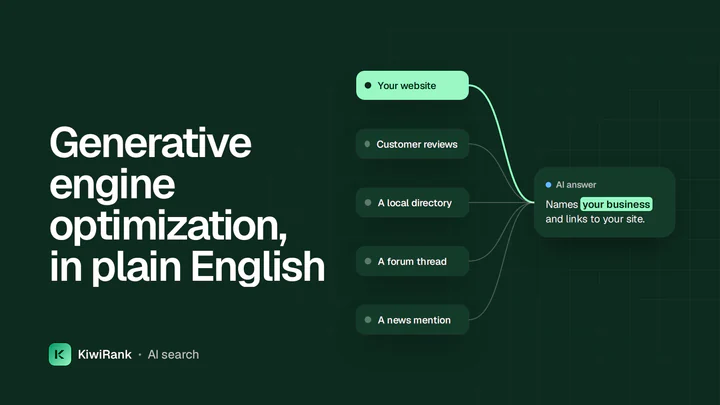
Then look beyond your own site. Bigeye reports that brands are 6.5 times more likely to be cited through third-party sources than through their own domains, and that brand websites make up only 5% to 10% of the sources AI systems reference. The rest comes from review platforms, Reddit and Quora, industry publications and comparison sites.
Each engine also behaves differently. NuroSparx points to an analysis of 680 million citations finding that only about 11% of domains are cited by both ChatGPT and Perplexity. It adds that Perplexity cites material published in the last 30 days at roughly an 82% rate, while ChatGPT leans more on established authority. Fresh pages help you get picked up fast. Steady authority keeps you there.
- Straight answers to the exact questions buyers ask
- Consistent facts: the same name, service area and details everywhere
- Outside proof: reviews, mentions and citations from others
- Readable structure: clean headings and structured data
That four-part summary comes from Angarum Media, and it is a handy way to remember the whole job.

Get your business named: a step-by-step plan
You do not need a new website. Most of the work is fixing access, rewriting key pages and tidying your listings. Follow these steps in order.
- Let AI search crawlers in. Check your robots.txt allows OAI-SearchBot, Claude-SearchBot and PerplexityBot. Omni Online Strategies notes OpenAI says sites that opt out of OAI-SearchBot are not shown in ChatGPT search answers.
- Confirm your key pages are indexed in Google and not set to noindex or nosnippet. Google says a page must be indexed and eligible for a snippet to appear in AI Overviews or AI Mode.
- Rewrite your top service pages so the opening answers the main question: what you do, price range, area served and how to book. Omni cites HubSpot's advice to put the core answer in the first 40 to 60 words.
- Add a real FAQ to each service page, using the questions customers ask you on the phone.
- Make your business facts identical everywhere: website, Google Business Profile, directories, LinkedIn and social profiles.
- Ask every customer for a review, with no incentive and no screening. Omni notes Google's policy prohibits selectively soliciting positive reviews.
- Join the conversation where buyers read: answer genuine questions on Reddit and Quora under your real name.
- Keep publishing and refreshing. Bigeye reports that brands refreshing priority pages every 60 to 90 days keep stronger citation performance.
How long does this take? Omni Online Strategies estimates a small business can finish the first four weeks in about 10 to 15 hours in total, then about an hour a month. Results come in months, not days.
Consistency is where most businesses slip. Kathy Sizemore gives a clear example: if LinkedIn says business consultant, your website says visibility coach and your Google Business Profile says marketing strategist, AI gets confused. Pick one description and use it everywhere.
Write pages AI can quote
An AI pulls the opening of a section to decide whether it answers the question. So the first sentence should be the answer. Bigeye Agency says AI models pull answers from the first 40 to 80 words after a heading, and Moburst advises leading every page with the answer in the first 1 to 2 sentences.
Omni Online Strategies uses a plumber to show the difference. A page that opens with the company story gives an AI nothing to quote. A page that opens with how long water heater replacement takes, what it costs and how to book gives it a complete answer. Use your own real prices and times.
- Write headings as the questions buyers ask: how much does it cost, how long does it take, do you handle permits.
- Put a direct answer with a specific number, place or example in the first sentence under each heading.
- Follow with one or two sentences of supporting detail, then the nuance.
- Keep sections tight. Bigeye cites research putting the sweet spot at 120 to 180 words per section.
- Use tables for comparisons and lists for steps, so each piece can stand alone.
- Show a named author, publish date and updated date, and link each new piece to two to four related pages, as NuroSparx recommends.
Proof helps too. Omni cites the GEO research paper, where citing sources, adding quotations and adding statistics raised visibility by up to about 40 percent. Kathy Sizemore cites BrightEdge research finding brands optimized for AI visibility appeared in 18% of relevant AI answers, against 3% for non-optimized brands.
The catch is volume. Answering every buyer question, with fresh pages and steady internal links, means publishing often. That is the work KiwiRank takes off your plate: it reads your website, then plans, writes, illustrates and publishes an SEO article every day, built to be found on Google and in AI answers.

What to skip
Plenty of AEO advice wastes your time. These are the common traps.
- Special AI files. Amsive notes Google's official guidance says no special AI markup, prescribed chunk size or AI text file is needed for AI Overviews and AI Mode. Omni adds that Google says you do not need llms.txt.
- Schema as a shortcut. Accurate structured data that matches the visible page is good practice, but Omni reports Ahrefs found no citation lift from adding JSON-LD to pages already cited more than 100 times.
- Keyword stuffing. In the GEO paper's benchmark, cited by Omni, it performed about 10 percent worse than the unmodified baseline.
- Long warm-ups. Three paragraphs of setup before the point means the AI quotes someone else.
- Paying for guarantees. Nobody controls what an AI assistant says, so any promise of a guaranteed mention is a red flag.
- Treating AEO as separate from SEO. Bigeye warns brands that split them struggle in both.
How to check whether AI names your business
You cannot improve what you never look at. The simplest check is free: ask the questions your customers ask, and see who gets named.
- Write down 20 questions a buyer would ask, such as best [your service] near [your area] or how much does [your service] cost.
- Ask each one in ChatGPT, Gemini, Perplexity and Google, where AI Overviews appear.
- Repeat each question a few times, because single answers vary.
- Record whether you are named, cited as a source, or missing, and which competitors appear instead.
- Repeat monthly and compare. Fix the pages behind the questions where you are missing.
Omni Online Strategies recommends this exact routine of 20 questions a month. It also gives you a baseline before any work begins.
Watch the business side as well. Amsive cites HubSpot's 2026 State of Marketing data: 49% of marketers had seen search traffic fall because of AI answers, and 58% described AI referral traffic as high intent. Track the visits and leads that arrive from AI tools, not just mentions.
If running prompts by hand gets old, KiwiRank also tracks your AI answer visibility and finds the Reddit and Quora threads where buyers are reading, so you can see where you show up and where to join in.
Conclusion
Getting named in ChatGPT and Google AI Overviews comes down to a few plain habits. Let the crawlers in. Answer the question first. Keep your facts identical everywhere. Earn reviews and real mentions on other sites. Publish and refresh often, then check each month which questions name you. None of it needs tricks or special files. If you want the publishing done for you, KiwiRank writes and publishes an article for your business every day, tracks your AI answer visibility and finds the Reddit threads where buyers are reading. Try it and track whether AI names you.
Frequently asked questions
Is answer engine optimization different from SEO?
It builds on SEO rather than replacing it. SEO earns rankings and clicks. AEO aims to get your business named or quoted inside AI answers. Because AI engines draw heavily on pages that already rank, you need both.
Do I need an llms.txt file or special schema?
No. Google's guidance says no special AI markup or AI text file is needed for AI Overviews. Keep structured data accurate and matching the visible page, but do not treat it as a shortcut.
How long until ChatGPT or Google names my business?
Expect months, not days. Some quick wins, like a clear answer page, can land sooner, while authority from reviews, mentions and steady publishing builds over time.
Do small local businesses benefit from AEO?
Yes. People ask AI for the best option near them, and the answer wants specifics: service area, hours, prices and reviews. A focused local business can supply those clearly.
What is the very first thing to do?
Make sure AI search crawlers can reach your site and your key pages are indexed. Then rewrite your top service pages so the direct answer comes first.