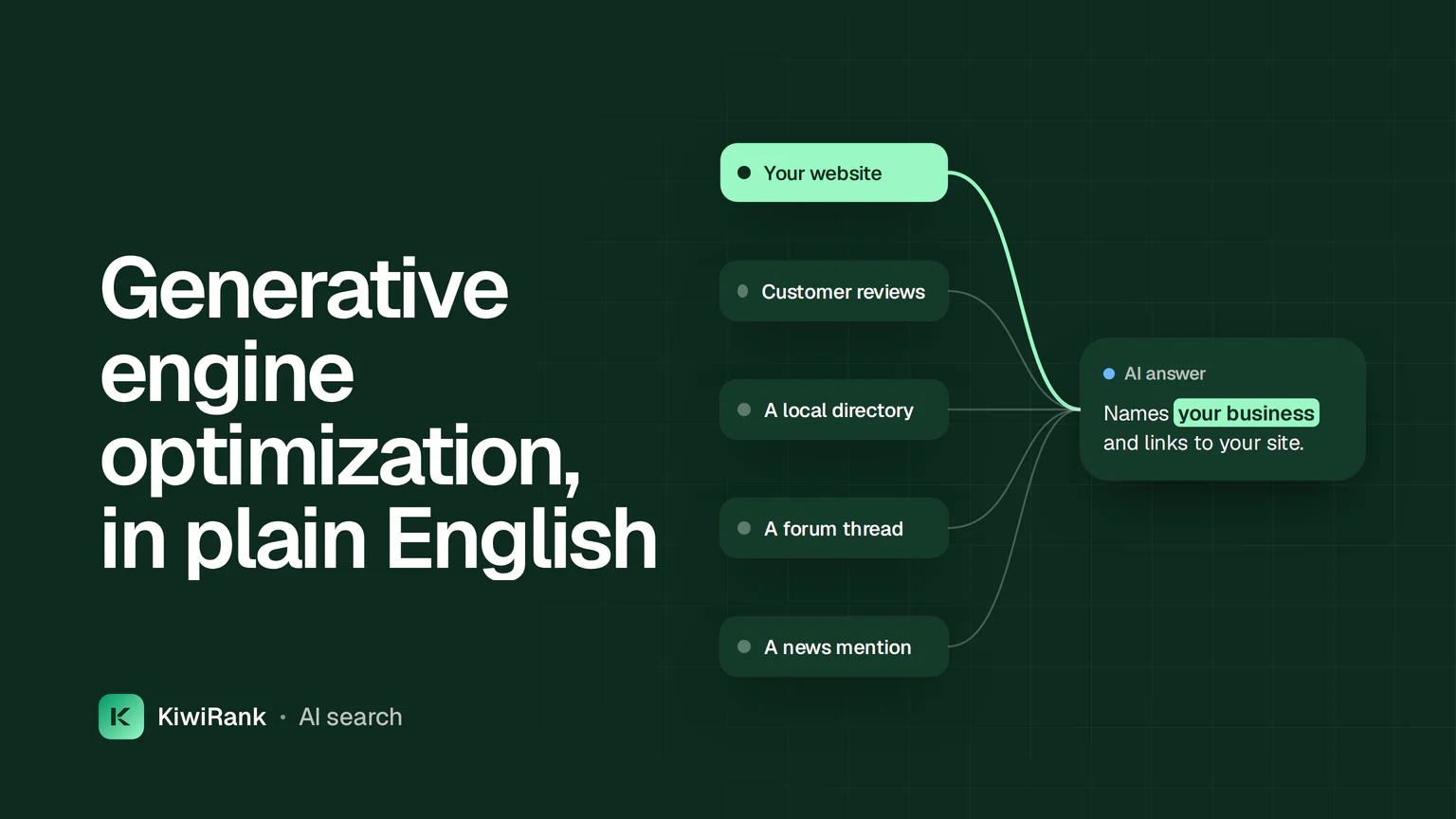
Generative engine optimization (GEO) is the work of making your business easy for AI tools like ChatGPT, Google AI Overviews and Perplexity to find, trust and name in their answers. SEO gets you onto the list of links. GEO gets you into the answer itself. It builds on solid SEO rather than replacing it.
GEO in plain English
Generative engine optimization is how you get your business mentioned when someone asks an AI tool a question. Instead of fighting for a spot on a page of links, you are trying to become one of the few sources the AI uses to write its answer.
Picture a homeowner who needs a plumber. They used to scan 10 blue links. Now, as business.com puts it, they increasingly ask an AI assistant and get two or three business names back. If yours is one of them, you win the call. If not, you never got a look.
Danny Tsui of ByteSimple sums it up neatly: getting quoted vs. getting clicked. The AI might never link to your site. But your name is in the answer, and that is the new form of being found.
One quick clarification. GEO here has nothing to do with geography or geo-targeting. It is about generative engines, the AI tools that write answers rather than list pages.
Where the term came from, and the other names you will hear
GEO did not start as a marketing buzzword. According to business.com, researchers from Princeton University, Georgia Tech and IIT Delhi coined the term in a 2024 paper. They built a benchmark of roughly 10,000 queries and found that adding citations, quotations and statistics to a page improved its visibility in AI answers by as much as 40 percent.
Since then, the labels have multiplied. You will see answer engine optimization (AEO), large language model optimization (LLMO), AIO and plain "AI SEO". Business.com calls them virtually synonymous, and notes that Google's documentation treats AEO and GEO as two names for one thing.
Straight North draws one small distinction: AEO leans a bit toward classic answer boxes and featured snippets, while GEO leans toward the newer generative layer. For a business owner, the target is the same. Get your name into the answer. Pick whichever term you like and focus on the work.
How GEO differs from SEO
SEO and GEO share most of their foundations. The difference is the finish line. SEO aims for a high ranking and a click. GEO aims for a mention or citation inside a written answer.
| Traditional SEO | GEO | |
|---|---|---|
| Goal | Rank on a results page | Get named or cited inside an AI answer |
| What you measure | Rankings, clicks, organic traffic | Citations, brand mentions, share of voice in AI answers |
| Unit of competition | The page | The answer |
| Content style | Keyword-focused pages | Clear, question-and-answer passages written in plain language |
| Where it shows up | Google's list of links | ChatGPT, Google AI Overviews, AI Mode, Perplexity, Gemini |
Google itself does not see a hard line between the two. Business.com reports that Google published its first official documentation on optimizing for AI search features in May 2026, and that it states optimizing for generative AI search is still SEO. If a page is not indexed or eligible for Google Search, it cannot appear in Google's AI features either.
There is a catch. Google only speaks for its own AI Overviews and AI Mode. Business.com points out that ChatGPT sends the large majority of measurable AI referral traffic, and it makes its own decisions about what to cite. So strong SEO is necessary, but it is not the whole job.
How much overlap is there? Sources disagree. ByteSimple says 85% of pages ChatGPT cites also rank in Google's top results. Straight North cites one large-scale analysis finding only 17% of AI Overview citations came from pages in Google's organic top ten, down from about 76% in mid-2024. Both point to the same lesson: ranking helps, but being cited is its own skill.

Why this matters for your business now
Your customers are already asking AI. ByteSimple notes that ChatGPT has over 800 million weekly users and that about 60% of people never click a link anymore.
Estimates of how often Google shows an AI Overview vary. ByteSimple puts it at roughly 60% of searches. Straight North cites industry estimates of 40% to 48% of searches by mid-2026. Either way, a big slice of searches now starts with an AI summary.
Local buyers are moving fastest. A BrightLocal survey of 1,002 U.S. adults, reported by business.com, found that use of AI tools for local business recommendations rose from 6 percent to 45 percent in a year. That made AI the third most common source of recommendations, behind Google and Facebook.
Other businesses are paying attention too. In a Straight North survey of 101 marketers, 73% said AI-search visibility already has a place in their strategy, and only 11% said they are doing nothing yet. Notably, 68% had increased their traditional SEO investment at the same time. They are adding GEO, not swapping.
And people like the format. Network Solutions cites data showing 43% of users prefer AI-generated answers for quick information over traditional search results.
What makes an AI tool name your business
AI tools do not pick businesses at random. They look for signals that make you easy to understand and safe to recommend. Here is what keeps coming up across the guides on the topic.
- Clear, direct answers. AI pulls individual passages, not whole pages. A short paragraph that plainly answers a common question beats a poetic sales pitch.
- FAQ sections. Each question mirrors something a real customer might type into ChatGPT, so you are formatting answers in advance.
- Consistent business details. Your name, address and phone number should match across your website, Google Business Profile, Yelp, Facebook and directories. AI tools cross-check these.
- An up-to-date Google Business Profile. Hours, photos, services and a clear description all feed local answers.
- Reviews. Quantity, quality and freshness matter. In the BrightLocal survey business.com reports, 74 percent of consumers look for reviews from the previous three months.
- Structured data. Schema markup tells machines what your business is, where it operates and what it offers.
- Original experience. Google's guidance, as business.com describes it, favours content with a real point of view over generic tips anyone could write.
- Mentions elsewhere. Directories, review sites and forum threads on Reddit and Quora often show up as sources in AI answers.
Reply adds a few writing habits worth copying: answer first and explain after, cut the fluff, cite credible sources and show a visible update date. Those habits help human readers too.
Notice what is missing from that list. No secret code. No special AI index to submit to. Most of it is clear writing and tidy business information, done consistently.
Five things you can do this week
You do not need a developer for a first pass. ByteSimple lays out five quick wins it estimates take about 100 minutes in total.
- Ask ChatGPT about your business. Type your business name, then questions like "best [your service] in [your city]". Try 3-4 variations. What comes back is your baseline.
- Update your Google Business Profile. Check your hours, add current photos and write a description that says what you do, where you are and who you serve.
- Add FAQs to your most important page. Pick one service or location page and add 5-6 real customer questions with short, direct answers.
- Check your name, address and phone number everywhere. Search your business name, look at each directory listing and fix any mismatch.
- Ask for reviews. Text or email your last 10 happy customers with a direct link to your Google review page.
Then repeat step one in a few weeks. Seeing your name appear, or not, in AI answers is the simplest progress report you will get.

What you can safely ignore
GEO has attracted a lot of noise. Business.com warns that much of what GEO vendors sell appears on Google's list of tactics you can safely skip. Keep these in mind before you spend money.
- Panic. Traditional search is not disappearing. People still Google things and still click links.
- Rewriting your whole site. Start with your most important pages, add FAQs and clean up structure.
- Tricks that replace substance. If your fundamentals are weak, business.com notes, no AI-specific tactic will make up for them.
- Assuming one platform covers all. ChatGPT, Claude, Perplexity and Copilot draw on their own indexes and often disagree on sources, according to business.com. Showing up in one is no guarantee for the others.
- Treating it as a one-off project. Straight North stresses that AI citations shift as engines re-crawl and retrain, sometimes week to week.
How to keep it going without writing everything yourself
GEO rewards steady output. Every clear, useful article you publish is another passage an AI tool can quote and another answer to a question your buyers ask. Fresh content also signals that your information is current, a point both Reply and Network Solutions make.
The hard part for most founders is time. That is the problem we built KiwiRank to solve. It reads your website, then plans, writes, illustrates and publishes an article for your business every day, made to be found on Google and in AI answers.
It also tracks how visible you are in AI answers, so you can see whether your name is showing up. And it finds Reddit and Quora threads where buyers are already reading, the same community spaces that often feed AI answers.
Whether you use a tool or do it by hand, the routine is the same: publish clear answers, keep your business details consistent, collect reviews and check what AI tools say about you on a regular basis.
Conclusion
GEO is simply about getting your business named when customers ask AI for help. You do not need new jargon or a separate playbook. Write clear answers to real questions, keep your details consistent, earn fresh reviews and keep publishing. Do that, and you give Google, ChatGPT and other AI answers every reason to mention you. Start with the five quick wins this week. If you want the publishing part handled for you, KiwiRank writes and publishes an article for your business every day and shows you how visible you are in AI answers.
Frequently asked questions
Does GEO replace SEO?
No. GEO builds on SEO. Google's own guidance, as reported by business.com, treats optimizing for AI search as still being SEO. Good rankings, a fast mobile-friendly site and quality content remain the base.
Is GEO only for big companies?
No. Local and smaller businesses can win specific questions like "best AC repair near me" that big brands do not target. Clear content, consistent listings and reviews matter more than budget.
How do I check whether AI tools mention my business?
Open ChatGPT and ask the questions your customers would ask, such as "What is the best [your service] in [your city]?" Try a few variations and note whether your name appears. Repeat over time to spot changes.
Do I need schema markup for GEO?
It helps. Structured data tells AI tools what your business is, where it operates and what it offers. Reply suggests Article, FAQPage and Author schema for content pages, and ByteSimple highlights LocalBusiness schema for local firms.
How long does GEO take to work?
There is no fixed timeline. AI citations shift as tools update, so treat GEO as an ongoing habit, like SEO, rather than a one-time project.