AI SEO is two things at once: using AI to speed up research, drafting and optimisation, and shaping your content so Google and AI answer engines quote it. It is not a shortcut that replaces strategy or expertise. Used well, with a human checking every claim, it helps you publish more useful pages and get found in more places.
What AI SEO actually means
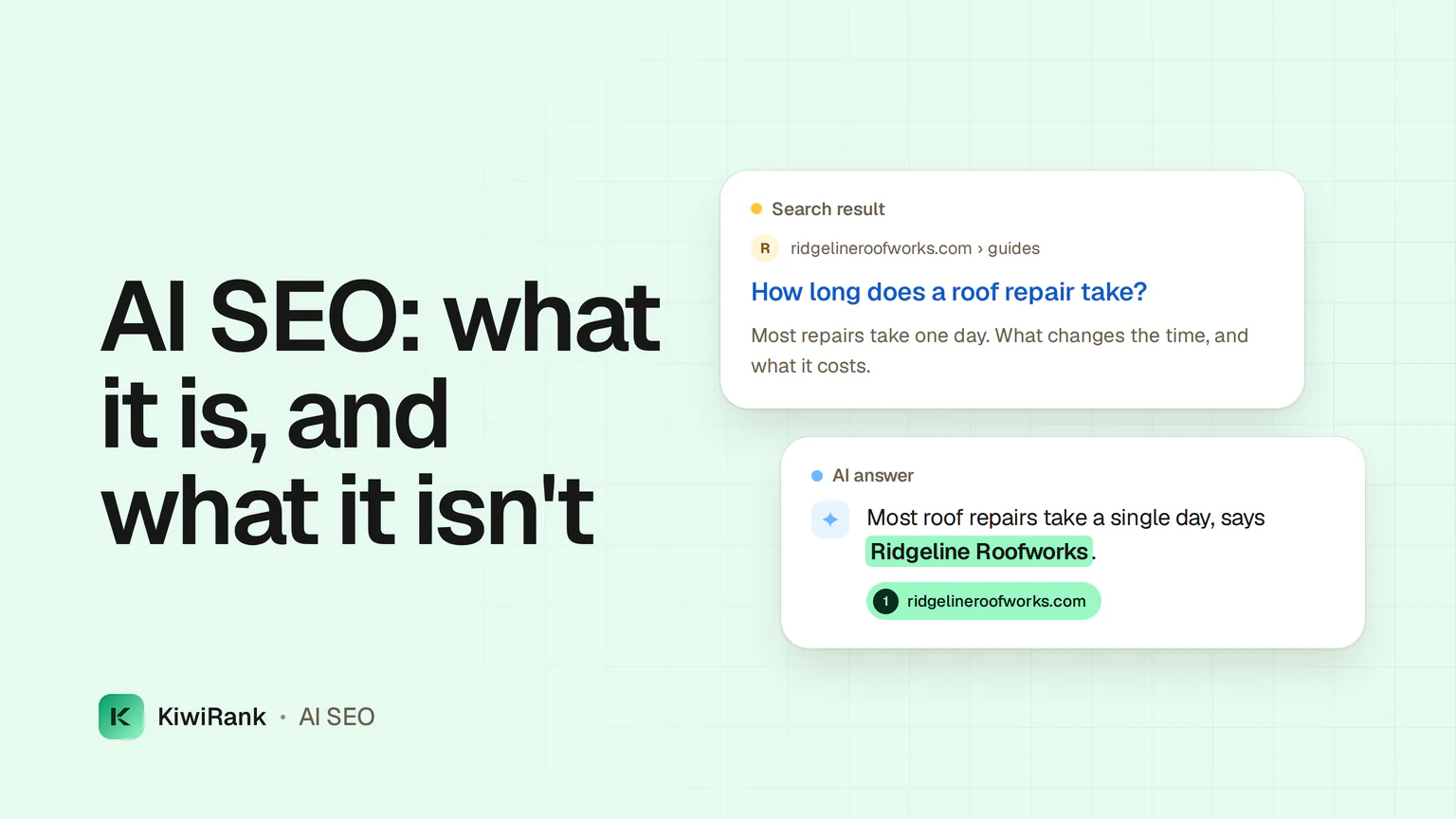
AI SEO has two meanings, and you need both. The first is using AI to do SEO work faster. The second is making your content easy for AI systems to find, trust and quote.
Salesforce describes AI SEO as applying artificial intelligence and machine learning to optimise websites and content for search engines, with the aim of better rankings and more organic traffic. That covers the first meaning: keyword research, content creation, on-page fixes and link building, all sped up by machines.
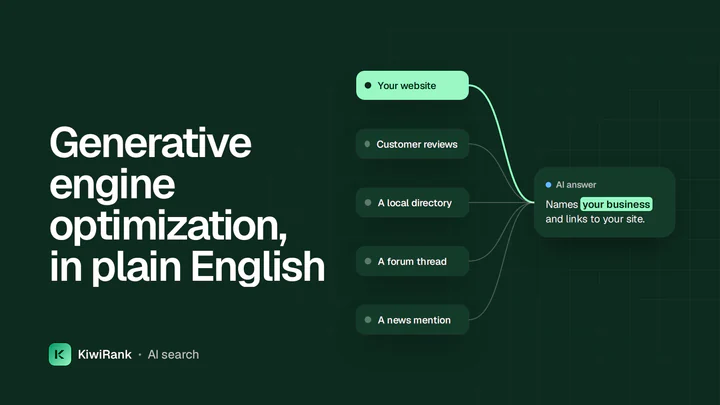
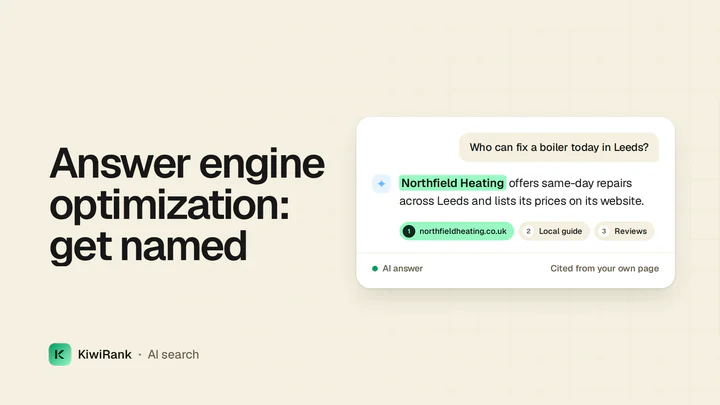
The second meaning is newer. Your buyers now ask ChatGPT, Gemini or Perplexity, or read a Google AI Overview, before they ever click. Getting named in those answers is part of the job. Some people call this GEO (generative engine optimisation) or AEO (answer engine optimisation). In practice, it sits inside SEO, not beside it.
Put simply: AI SEO is how you get found on Google and in AI answers, with AI doing the heavy lifting and people keeping it accurate.
What AI SEO isn't
A lot of noise surrounds this topic. Clear out the myths first, so you spend your time on what moves traffic.
- It isn't the end of SEO. Rankings still matter, because Google is still where a lot of high-intent demand gets captured. The work changed shape; it didn't disappear.
- It isn't a button that writes rankings. Nitin Kamani puts it bluntly in his LinkedIn guide to AI for SEO: AI alone does not improve rankings, and Google does not reward content just because AI wrote it.
- It isn't a licence to mass-publish. Pages with no added value get filtered out, whoever or whatever wrote them.
- It isn't free traffic. As Factors points out, organic visibility takes sustained investment in content, technical health and credibility. The cost is different from ads, not absent.
- It isn't a replacement for judgment. AI can cluster keywords and draft pages. It can't decide which opportunities fit your business or what your brand should stand for.
Why AI SEO matters for your traffic now
Search results now answer many questions on the page. Fewer people click through. That changes what winning looks like.
Unframed Digital, citing SparkToro's 2026 study, reports that 68% of US Google searches ended with no click to any site in early 2026, up from 60.45% in 2024. Open-web clicks fell from 374 to 276 per 1,000 searches over the same window. The same article cites a Pew Research study: with an AI Overview present, only 8% of users click an organic result, against 15% without one.
| Finding | Figure | Reported by |
|---|---|---|
| US Google searches ending with no click, early 2026 | 68% (up from 60.45% in 2024) | Unframed Digital, citing SparkToro |
| Users clicking an organic result when an AI Overview shows | 8% (15% without one) | Unframed Digital, citing Pew Research |
| Pages cited in AI Overviews that also rank in Google's top ten | 38% (down from 76% in 2025) | Unframed Digital, citing Ahrefs |
| Chance a number-one Google ranking appears in AI answers | 31% | Neil Patel, NP Digital |
| Six-word queries that trigger AI Overviews | 77% | Neil Patel, NP Digital |
The rankings gap is the striking part. In a LinkedIn video post, Neil Patel says NP Digital studied 500 commercial keywords and ran 4,300 related prompts through AI models. Ranking first on Google gave only a 31% chance of appearing in AI answers, and 75% of AI citations went to sources outside Google's top 10.
There's good news in the same post. Patel says AI traffic converts at roughly 9% in NP Digital's comparison, the highest of the channels they looked at. People arrive having already read an answer that named you. Fewer visitors, warmer visitors.

Where AI helps, and where you stay in charge
The best results come from splitting the work. AI handles volume. People handle direction, facts and voice. SEO Optimizers frames it well: treat AI as a research and drafting layer with a human editor on top.
| Task | Let AI do this | Keep a human on this |
|---|---|---|
| Keyword research | Generate long-tail variations, cluster topics, sort by intent | Pick keywords that match your business goals and revenue |
| Content briefs | Build outlines, headings and FAQ ideas | Choose the angle and what makes the page different |
| Drafting | Write first drafts fast | Add real examples, check every claim, set the voice |
| Technical SEO | Summarise crawl reports, flag broken links and duplicate content | Decide what to fix first and implement it |
| Reporting | Summarise trends in GA4 and Search Console | Interpret what the trends mean for your plan |
Kamani claims AI can speed up keyword research by 70–80%. Speed is the easy win. The harder part is making sure faster output is also better output.
Some jobs shouldn't go to AI at all. Kamani lists thought leadership, case studies, brand storytelling and finance, health or legal content as areas that need real experience or expert validation.
How to use AI SEO to grow organic traffic
Here's a plain process you can run every week. It works whether you write in-house or hand the writing off.
- Start from the outcome. Pick the result you want: more trials, demos or sales. Then work backward to the questions buyers ask before they buy.
- Map the questions. Pull the top results and People Also Ask data for your topic. Ask AI to group them into themes and flag questions nobody answers well.
- Check who AI cites today. Run your core questions through ChatGPT, Perplexity and Google. Note which sources get named and why.
- Brief around the gaps. Build each page around what's missing, not what already ranks.
- Draft with AI, edit as an expert. Let AI write the outline and first draft. Then add your own data, examples and a clear point of view.
- Fact-check everything. AI drafts sound confident and still get facts wrong. Verify every number against a primary source.
- Publish consistently. Steady output builds topical depth, which both Google and AI systems reward.
- Refresh what you have. Update stats, add an FAQ block and tighten thin sections on your highest-value pages.
Consistency is where most teams stall. If you'd rather not write at all, KiwiRank plans, writes and illustrates an article for your business every day, made to be found on Google and in AI answers. You keep the strategy; it handles the daily publishing.

Write pages that AI answers can quote
AI systems don't just look for the top-ranking page. According to Usercentrics, they break a question into sub-questions, pull from several sources and cite what they consider safe to reuse. In their words, AI picks the best-supported answer, not the best page.
Usercentrics groups those sub-questions into five facets. Cover all five and you give AI fewer reasons to stitch a competitor into the answer.
- Functional: does your product solve the problem? State capabilities and use cases plainly.
- Comparative: how do you compare with alternatives? Offer fair comparisons and pros and cons.
- Contextual: is it right for this buyer? Explain fit by company size, industry or region.
- Implementation: what does setup take? Be honest about effort and time to value.
- Economic: what does it cost, and how does cost scale? Give clear trade-offs, not vague value claims.
Structure matters as much as coverage. Unframed Digital recommends answering the main question in the first 40 to 60 words, then expanding. Use descriptive headings, FAQ blocks and tables a model can lift cleanly. Mark up articles and FAQs with schema.
Freshness counts too. Patel says content older than 18 months without updates shows declining citation rates. Put your key pages on a refresh calendar.
Finally, show up beyond your own site. AI systems weigh how often a brand is named across trusted sources, such as reviews, comparison articles and community threads. Being part of real conversations, including on Reddit, helps AI see you as a source worth naming.
Measure what counts now
If you judge AI SEO by sessions alone, you'll misread your results. Traffic can look flat while visibility and revenue grow. Track a wider set of signals.
- AI citations: how often ChatGPT, Perplexity and Google AI Overviews name you for your core topics.
- Share of voice: your visibility on priority prompts compared with competitors.
- Branded search: Patel says SMBs with working AI SEO can see direct branded searches jump 25 to 50%, because people read an AI answer and then search your name.
- AI referral traffic and its conversion rate: segment sessions from ChatGPT, Perplexity, Claude or Gemini in GA4.
- Classic rankings and organic traffic: still useful, now as context rather than the whole story.
A simple habit works: type your core questions into a few AI tools each week, save the answers and watch whether your name appears more often.
Mistakes that cost you traffic
- Publishing raw AI drafts. Generic content sounds like everyone else's because many people use similar prompts.
- Scaling thin pages. Unframed Digital reports that analyses of Google's 2026 core updates found sites publishing hundreds or thousands of unedited AI articles losing 40% to 80% of their traffic.
- Trusting AI's facts. Models invent statistics and cite sources that don't say what they claim.
- Burying the answer. If your key point takes five paragraphs to reach, AI is less likely to reuse it.
- Inconsistent branding. Old product names and stale positioning across your site and listings confuse AI systems.
- Watching only clicks. You can lose sessions and still gain buyers. Check citations and branded search before you panic.
Conclusion
AI SEO isn't magic and it isn't the end of search. It's a faster way to do the work, plus a new place to get found. Let AI handle research, outlines and drafts. Keep people on strategy, facts and voice. Write answer-first pages that cover what buyers really ask, refresh them, and track citations and branded search alongside traffic. Do that steadily and you grow organic traffic on Google and in AI answers. If you want the daily writing done for you, KiwiRank plans, writes and publishes an article every day so your business keeps getting found.
Frequently asked questions
Is SEO dead because of AI?
No. The work changed, not the need. Rankings still capture high-intent demand on Google, and AI answers add a second place to get found. Success now spans clicks, AI citations and brand mentions.
Will Google penalise AI-written content?
Google doesn't reward content for being AI-written, and it doesn't reward thin pages either. Well-edited, useful AI-assisted content can rank. Mass-produced, unedited pages are what get demoted.
What's the difference between SEO and GEO?
SEO helps you rank and earn the click on search results. GEO helps you get included and cited inside AI-generated answers. Both rely on the same basics: clear, well-structured, trustworthy content.
How do I know if my AI SEO is working?
Look beyond sessions. Check whether AI tools cite you for your core topics, whether branded searches are rising in Google Search Console, and how AI referral traffic converts in GA4.